
What Is Akhand Bharat in Hindu Scriptures is a question frequently discussed in political, historical, and religious debates. Many people claim that ancient Hindu scriptures support the idea of Akhand Bharat as a united civilizational or territorial identity covering large parts of South Asia. However, when the original scriptures and classical texts are examined carefully, the reality appears more complex than modern narratives often suggest, This article explores What Is Akhand Bharat? Myth vs Reality through scriptural references found in texts such as the Baudhayana Dharmasutra, Vasishta Dharmasutra, Manusmriti, Mahabharata, and various Puranas. The focus is on understanding how ancient texts described Aryavarta, Bharata-varsha, regional peoples, and cultural boundaries according to their own historical context, Several Hindu scriptures describe Aryavarta as a restricted geographical region rather than the entirety of modern India or South Asia. Some passages distinguish between Aryavarta and lands considered outside sacred or ritual boundaries. Other texts contain references to mlecchas, mixed peoples, easterners, southerners, and tribes living beyond the traditionally accepted regions of Aryavarta, The debate surrounding Akhand Bharat history and mythology often mixes ancient scriptural references with modern political interpretations. This article does not attempt to support or oppose Akhand Bharat ideology. Instead, it presents historical and textual evidence related to Akhand Bharat in Hindu scriptures, allowing readers to examine the sources directly, By analyzing scriptural descriptions of Aryavarta, Bharata-varsha, and ancient regional divisions, readers can better understand the difference between modern Akhand Bharat narratives and the actual references found in traditional Hindu literature. The goal is clarity through sources, helping readers explore What Is Akhand Bharat? Myth vs Reality without modern assumptions or political reinterpretation.
1. Geographical description of the Aryavarta
📚Baudhayana Dharmasutra 1.2.9-15📚
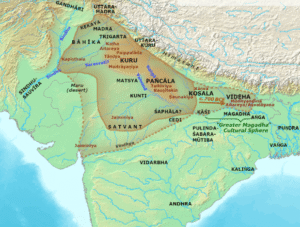
The country of the Āryas (Āryāvarta) lies to the east of the region where (the river Sarasvatī) disappears, to the west of the Black-forest (Kālakavana), to the north of the Pāripātra (mountains), to the south of the Himālaya. The rule of conduct which (prevails) there, is authoritative. mSome (declare) the country between the (rivers) Yamunā and Ganges (to be the Āryāvarta). Now the Bhāllavins quote also the (following) verse: ‘In the west the boundary-river, in the east the region where the sun rises,–as far as the black antelopes wander (between these two limits), so far spiritual pre-eminence (is found).’ The inhabitants of Avantī, of Aṅga, of Magadha, of Surāṣṭra, of the Dekhan, of Upāvṛt, of Sindh, and the Sauvīrās are of mixed origin. He who has visited the (countries of the) Āraṭṭas, Kāraskaras, Puṇḍras, Sauvīras, Vaṅgas, Kaliṅgas, (or) Prānūnas shall offer a Punastoma or a Sarvapṛṣṭhā (iṣṭi). Now they quote also (the following verses): ‘He commits sin through his feet, who travels to the (country of the) Kaliṅgas. The sages declare the Vaiśvānarī iṣṭi to be a purification for him.” (source)
📚Vasishta Dharmsutra 1.8-11📚
The country of the Āryas (Āryāvarta) lies to the east of the region where (the river Sarasvatī) disappears, to the west of the Black-forest, to the north of the Pāripātra (mountains), to the south of the Himālaya. (According to others it lies to the south of the Himālaya) and to the north of the Vindhya range (being limited east and west by the two oceans). Acts productive of spiritual merit, and customs which (are approved of) in that country, must be everywhere acknowledged (as authoritative); But not different ones, (i.e. those) of (countries where) laws opposed (to those of Āryāvarta prevail).” (source)
📚Manusmriti 2.22-23📚
The country extending as far as the Eastern Ocean and as far as the Western Ocean, and lying between the same two mountains,- the learned know as ‘Aryavarta’. But the region where the spotted deer roams by nature is to be known as the land fit for sacrificial acts’; beyond that is the land of the Mlecchas.” (source)
2. How does the ‘Aryavarta’ look like according to the Hindu Scriptures
3. Kalki will annihilate people residing in various parts of India
📚Vayu Purana 1.58.81-84📚
He killed the Udicyas (northerners), Madhya Desyas (people of the Middle Land), mountain-dwellers, easterners, westerners, dwellers in Vindhya and Aparanta. He killed the southerners, Dravidas, Simhalas, Gandhäras, Paradas, Pahlavas, Yavanas, Tusaras, Barbaras, Cinas, Sülikas, Daradas, Khasas, Lampakas, Ketas, and the different tribes of Kiratas. Setting his wheel (of religious victory) in motion, the powerful lord, the destroyer of Mlecchas, roamed over the earth. He could not be thwarted by any living being.” (source)
4. Penance for visiting Sindhu, East Bengal etc
📚Devala Smriti Verse 16📚
For one who has gone to the lands of the Indus, Sauvira, Saurashtra also to the border-dwellers lands of Kalinga, Konkana & Vanga-expiatory rites are necessary (for him).” (source)
5. Hatred against Easterners and Southerners
📚Mahabharata 8.45📚
The easterners (East Indians) follow the practises of Shudras…” (source)
📚Mahabharata 8.45📚
the Southerners are fallen…” (source)
6. Hatred against Non-Aryans (Mlechhas)
📚Mahabharata 8.45📚
The mlecchas are the dirt of mankind…” (source)
7. Hatred against Punjabis
📚Mahabharata 8.45📚
the Madra (Punjabi) women are the dirt of the whole female sex…” (source)
📚Mahabharata 8.45📚
The Vahikas are the dirt of the Earth…” (source)
📚Mahabharata 8.45📚
The Vahikas, however, live without righteousness…” (source)
📚Mahabharata 8.45📚
the Vahikas are thieves…” (source)
📚Mahabharata 8.45📚
Beginning with the Matsyas, the residents of the Kuru and the Pancala countries, the Naimishas as well and the other respectable peoples, the pious among all races are conversant with the eternal truths of religion. This cannot be said of the Madrakas and the crooked-hearted race that resides in the country of the five rivers.” (source)
📚Mahabharata 8.45📚
The Madrakas are regarded on Earth as the dirt of every nation. So the Madra woman is called the dirt of the whole female sex. They that have for their practices the drinking of spirits, the violation of the beds of their preceptors, the destruction of the embryo by procuring miscarriage, and the robbing of other people’s wealth, there is no sin that they have not. Fie on the Arattas and the people of the country of the five rivers.” (source)
8. Hatred against Saurashtras (Gujaratis)
📚Mahabharata 8.45📚
the Saurashtras are bastards. They that are defiled by ingratitude, theft, drunkenness, adultery with the wives of their preceptors, harshness of speech, slaughter of kine, lustful wanderings during the night out of home, and the wearing of other people’s ornaments,—what sin is there that they do not incur?” (source)
About This Article
The article “Truth Behind Akhand Bharat” presents a text-based and historical examination of references related to territorial, cultural, or civilizational concepts found in ancient Indian scriptures, epics, Puranas, and traditional texts. The focus is on what is explicitly mentioned in the scriptures and classical sources, including descriptions of regions, kingdoms, Bharata-varsha, and ancient geographical understanding, This article does not attempt to justify, promote, endorse, or advocate the concept of Akhand Bharat as a political, nationalistic, or modern ideological goal. It also does not reinterpret or harmonize texts to fit contemporary narratives. The content is limited to scriptural statements, traditional descriptions, and historical references as they appear in the sources, The purpose of this article is educational and analytical, allowing readers to understand how ancient texts describe land, civilization, and cultural boundaries, without drawing conclusions about present-day borders or political claims, Readers are encouraged to distinguish between scriptural descriptions, historical interpretations, and modern ideological usage of the term Akhand Bharat.